
Key takeaways
- Senior homelessness is rising. Seniors are one of the fastest-growing groups experiencing homelessness in B.C., often for the first time later in life.
- Financial insecurity is widespread. Many senior renters have low, fixed incomes and cannot absorb even small, unexpected expenses.
- Housing is increasingly unaffordable. A growing share of seniors spend more than 50%—and often more than 75%—of their income on housing.
- Rent banks provide effective early support. BC Rent Bank helps stabilize housing during short-term crises, preventing eviction and reducing homelessness risk.
- Sustained action is needed. Stable funding for BC Rent Bank, alongside strengthened income and housing supports, will be critical to prevent further increases in senior homelessness.
“I couldn’t believe I’ve managed to survive this long without a place to live. It’s been so long I can barely remember what it feels like to sleep on a mattress,” a 76-year-old man living in a park in Richmond told Fraser Valley News recently.1 A former art teacher who has diabetes and uses a walker, he has experienced homelessness for about a year.
Few experiences are more destabilizing than losing a home and the loss of safety, stability and well-being that goes with it.
While the Province has made important strides in addressing housing affordability and homelessness for seniors, without a sustained commitment to building community-owned affordable housing and supporting the sustainability of programs that support renters, this progress could be lost at a time when pressures are intensifying
BC Rent Bank is an example of one of these programs. Through a network of local rent banks, BC Rent Bank provides emergency financial assistance and support services to enable low- to moderate-income renters facing short-term financial crises to stay housed if facing eviction.
This Insight examines the growing risk of homelessness among seniors in B.C., its key drivers and the role of BC Rent Bank – alongside targeted income and housing supports – in preventing housing loss.
Many seniors in B.C. are at growing risk of eviction and homelessness
- Approximately 1 in 5 seniors in B.C. are renters.2
- The median household income of renters aged 65+ in B.C. is about $26,000 a year – half that of renters overall.3
- Nearly half of low-income seniors report they could not cover an unexpected $1,000 expense, according to a survey of low-income seniors in 2022.4
With this level of financial insecurity, homelessness among seniors is increasing and represents one of the fastest-growing groups experiencing homelessness in Canada. A recent point-in-time count of the people experiencing homelessness in 2025 showed that 1 in 4 people experiencing homelessness in Metro Vancouver are over 55 years of age.5 Almost half of the seniors in the count said they were experiencing homelessness for the first time as a senior. Counts in other municipalities, big and small, are similar.6
Seniors can become homeless due to life disruptions such as the loss of a partner (through death or divorce), financial abuse or administrative issues like failing to file taxes, which can delay benefits or lead to losing subsidized housing. Health crises can also be a major trigger—extended hospital stays may result in the loss of housing if landlords assume the unit has been vacated and re-rent it.
We know from data shared in the First United B.C. Evictions Map that eviction often results in homelessness – 43% of seniors (60+) reported that they had not found a new place to live after being evicted.7 Older adults who experience homelessness tend to remain so for longer and face greater health risks, while few services are designed to meet their needs.
BC Rent Bank data shows seniors are being squeezed
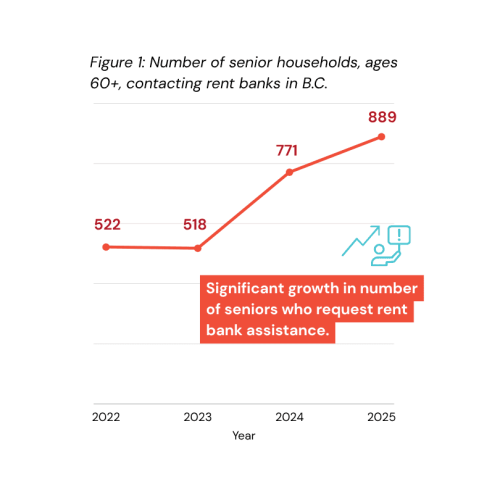
Annual data from BC Rent Bank show a significant growth in the number of seniors facing eviction that request assistance from a rent bank.
Most seniors seeking help have very unaffordable housing situations. According to BC Rent Bank data:
- Almost three quarters of households spend more than 50% of their income on housing.
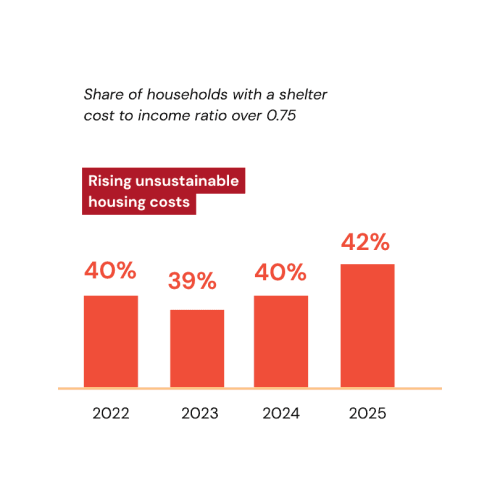
- Forty percent spend more than 75% of their income on housing.
The data also show the share of seniors who contact rent banks with very unsustainable housing costs (a ratio of 75% or higher) is rising rather than decreasing.
Housing crises are often triggered by unexpected expenses, income loss or major life changes that fixed incomes cannot absorb.
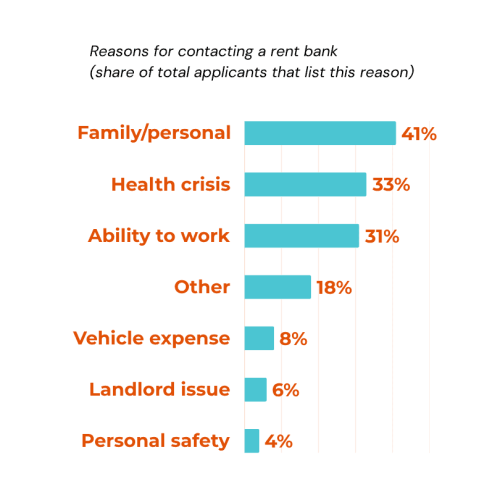
Behind the data are people facing complex challenges: a roommate leaving without paying rent, financial abuse or fraud, fire-related loss of belongings, unexpected health costs, delays in accessing government benefits and disruptions to employment for seniors who continue to work out of necessity.
Community rent banks report that many seniors typically navigate significant housing stress before requesting help, due to such factors as being unsure how to apply, or hesitant to seek help due to stigma or fear of consequences, including financial exploitation.
Why BC Rent Bank matters
BC Rent Bank enables renters, wherever they live, to apply for emergency financial assistance if facing an imminent threat of eviction from not being able to pay rent. BC Rent Bank was established in 2019 as a Government of B.C. funding partnership with Vancity Community Foundation, building on the experience of local rent banks operating in some communities. By establishing a provincial network of rent banks, the Province responded directly to what it heard from renters and community organizations through the Rental Housing Task Force.
Since that time, BC Rent Bank has served as a critical intervention tool to prevent housing loss and homelessness. Since 2022, rent banks across B.C. have provided:
- 883 instances of financial assistance to seniors (age 60+)
This support has enabled:
- 1,115 people to avoid eviction
By connecting with a local rent bank, seniors also receive community-specific information about other vital supports that can help them to maintain their housing, an important feature given that many seniors, particularly those who are isolated and who live alone, are difficult to connect with, even if they qualify for income and other supports.
This approach is far less costly than trying to help someone after they become homeless. We estimate the public cost savings for preventing homelessness for these senior-headed households assisted by BC Rent Bank to be approximately $5 million in shelter, healthcare and re-housing costs. In addition, these households avoid over $4.5 million by not incurring costs related to moving, storage and loss of possessions and having to pay higher rents in new housing.
Doing more to support seniors
The evidence in this Insight is clear: housing insecurity among low-income seniors is growing and will continue to increase without further action. BC Rent Bank is a practical, proven program that helps seniors remain housed during short-term crises. Stable, ongoing funding of BC Rent Bank is essential to maintain and expand access so seniors can receive support before eviction. At the same time, a coordinated approach is needed to address the underlying drivers of housing insecurity. This includes:
- Strengthening income security for low income seniors and working older adults. This includes enhancing and better targeting OAS and GIS for those with the lowest incomes, ensuring CPP provides more adequate income for people with limited or interrupted work histories or shorter residency in Canada and aligning disability and income assistance rates with the cost of living while enabling smoother transitions to retirement income at age 65. For seniors who continue to work, minimum wages should more closely reflect living wages to help supplement fixed incomes and reduce financial vulnerability.
- Improving rental assistance programs. Programs such as SAFER play a critical role in improving the housing security of seniors. Increasing the subsidy level and reducing administrative barriers would help more eligible seniors access support when it is needed.
- Expanding and protecting permanent, affordable housing options for seniors. This requires restoring and strengthening investment in programs such as the Community Housing Fund to ensure a steady pipeline of new non-market housing, alongside scaling efforts to preserve existing affordable rental homes. Success should be measured by a sustained reduction in waitlists for subsidized seniors’ housing, which has grown significantly in recent years.
Sources
1 Nono Shen, “Time All Blurs: Senior’s Journey from Shanghai Art Teacher to Homeless in B.C. Park,” Fraser Valley Today, June 8, 2026. View article
2 Statistics Canada, 2021 Census data, Table 98-10-0251-01
3 Statistics Canada, 2021 Census data, Table 98-10-0251-01 and Table 98-10-0244-01
4 Office of the Seniors Advocate (BC), Bridging the Gap: Seniors and the Cost of Living in B.C. (2022).
5 Homelessness Services Association of BC, 2025 Point-in-Time Homeless Count for Greater Vancouver
6 BC Housing, Homeless Counts